
What Is a 3PL Warehouse? A Complete Guide for E-commerce Sellers
 Smart Prep Center Team5 min read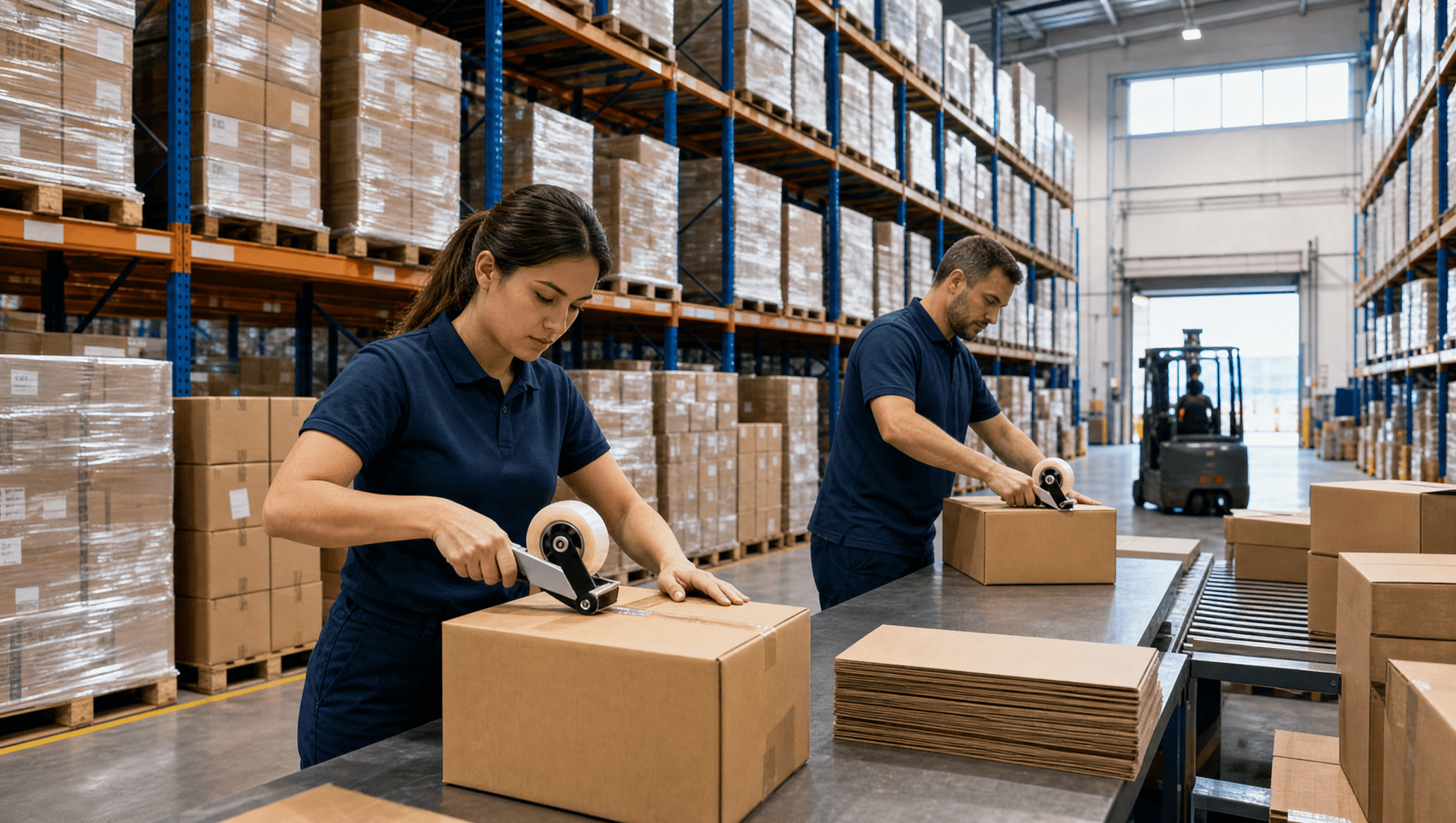
A 3PL warehouse (third-party logistics warehouse) is a building run by an outside company that holds your inventory and does the physical work for you: receiving goods from suppliers, storing them, picking and packing orders, shipping to customers or marketplaces, handling returns. You don't rent space and you don't hire warehouse staff. You pay the 3PL per item or per operation, and your evenings go back to sourcing and sales.
What Does a 3PL Warehouse Actually Do?
Day to day, a full-service 3PL sits between your factory and your customer and covers everything in between:
- Receiving. Parcels, pallets or whole containers arrive from your suppliers, get counted against your order and entered into inventory. Shortages get flagged on day one instead of surfacing three months later.
- Storage on racks or pallets until you need the goods. A decent 3PL bills only for the space you actually occupy.
- Prep and compliance — FNSKU labels, polybags, bubble wrap, suffocation warnings. This is what keeps a shipment from bouncing at Amazon, Walmart or eBay check-in.
- Pick and pack. An order comes in, staff pull the items, pack to carrier and marketplace specs, slap on the label.
- Shipping via UPS, USPS, FedEx or freight carriers, usually at commercial rates a single seller never sees.
- Returns: inspect, photograph, then restock, relabel or toss.
1PL, 2PL, 3PL, 4PL — What's the Difference?
The number in front of "PL" just tells you who runs the show:
Model | Who does the work | Example |
|---|---|---|
1PL | You do everything yourself | Shipping orders from your garage |
2PL | A carrier moves your goods | UPS delivers, but you store and pack |
3PL | An outside warehouse stores, packs and ships for you | Smart Prep Center |
4PL | An integrator manages several 3PLs and carriers for you | Enterprise supply-chain management |
For most small and mid-size sellers, 3PL is the sweet spot. The physical work is off your plate, but products, pricing and sales channels stay yours.
3PL Warehouse vs Prep Center: Which One Do You Need?
The two overlap a lot, and plenty of facilities (ours at Smart Prep Center included) are both.
A prep center exists to get inventory ready for marketplace fulfillment programs, mainly Amazon FBA: inspection, FNSKU labeling, polybagging, bundling, then forwarding to Amazon's warehouses. A 3PL goes further. It also stores inventory long-term and ships orders straight to your customers — FBM, Shopify, Etsy, Walmart, whatever you sell on.
Selling only through Amazon FBA? A prep center may be all you need. Multiple channels, inventory sitting between purchase and sale, or fulfilling orders yourself? That's 3PL territory. We wrote up the detailed comparison in Prep Center vs 3PL.
When Does an E-commerce Business Need a 3PL?
Signs it's time, based on what new clients tell us:
- Packing eats your selling time. Evenings spent labeling boxes are evenings not spent sourcing.
- You're out of space. Inventory in the living room, the garage, a self-storage unit down the road — you've outgrown self-fulfillment.
- You sell in the USA from abroad. International sellers on Amazon.com need a US address that can take containers, prep goods and push them into FBA. A 3PL is that address.
- Amazon's storage limits hurt. Capacity limits and steep FBA storage fees make it cheaper to hold bulk stock at a 3PL and feed Amazon in small batches.
- You've gone multichannel and one inventory pool now has to serve Amazon, Walmart, eBay, Etsy and your own Shopify store at once.
How Much Does a 3PL Warehouse Cost?
Pricing models vary, but a reputable 3PL charges per unit or per operation — never a cut of your revenue. For a reference point, these are our actual published Delaware rates for 2026:
- Receiving small parcels and pallets — free
- Receiving a 20′ container — $300, a 40′ container — $600
- FBA prep (inspection + FNSKU labeling) — from $0.50 per unit for wholesale and private-label sellers
- FBM order fulfillment — from $1.15 per unit at volume
- Pallet storage — from $0.70 per pallet per day, and free while inventory waits for prep
Two things people miss when comparing warehouses. Minimums: lots of 3PLs quietly require 100–500 units a month (we have no MOQ). And the state itself: Delaware has no sales tax, which is a big deal if you're an online-arbitrage seller buying inventory from US retailers. Every rate is on the pricing page.
How to Choose a 3PL Warehouse: 7-Point Checklist
- Location. An East Coast warehouse near the ports and I-95 shortens inbound from Asia via the Port of New York/New Jersey and puts a huge share of US customers within 1–2 ground days.
- Marketplace expertise — ask specifically about Amazon FBA prep. Wrong labels are the #1 reason shipments get rejected.
- A public rate card. "Request a quote" forms hide things.
- No hidden minimums; check MOQ and monthly fees before signing anything.
- Software and reporting: photos of received goods, live inventory counts, same-day notifications.
- Speed. Standard prep turnaround should be 24–48 hours. Not weeks.
- Communication — a named manager who answers the same day, ideally in your language.
FAQ: 3PL Warehouses
Is Amazon FBA a 3PL? Technically yes, Amazon stores and ships your goods. But FBA only takes prepped, labeled inventory and its storage fees sting. Most FBA sellers still run an independent 3PL or prep center upstream of Amazon.
Do I need a US company to use a US 3PL? No. Ship straight to the warehouse; the 3PL receives, preps and forwards to FBA or end customers. Plenty of our clients have never set foot in the US.
How fast can I start? About a day here. You get a receiving address, send the first shipment, and see photos when it lands.
Have questions about outsourcing your logistics? Contact Smart Prep Center — a 3PL warehouse and prep center in Newark, Delaware, working with Amazon, Walmart, Shopify, eBay and Etsy sellers since 2015.